A simple story on the hidden lens that guides our thoughts, reactions and choices.
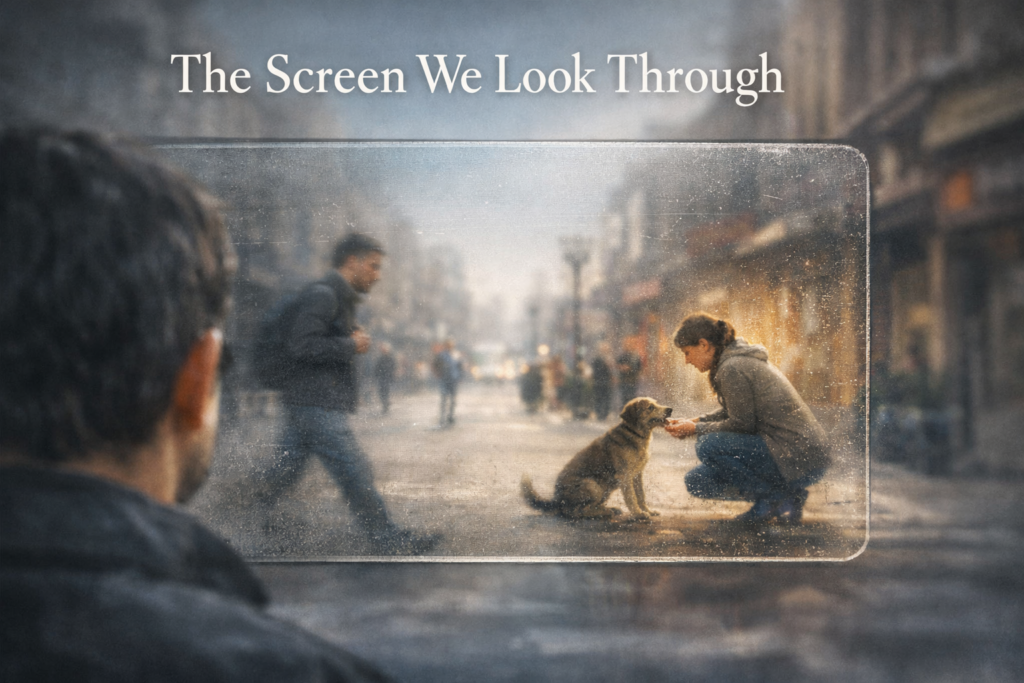
Ram and Shyam were sitting on the steps near their old school, watching people move along the street. A young man rushed ahead with irritation on his face. A little later, a woman paused near a stray dog, placed a biscuit in front of it and walked away smiling. Ram pointed at both of them and said he often wondered why people react so differently to the same world.
Shyam agreed. People always seemed impossible to understand. Ram told him maybe the real question was not why they behaved that way, but what they were seeing. Shyam assumed they were talking about the outer world, but Ram shook his head. He meant the world inside.
Ram explained that each person walks around with an invisible screen in front of their mind. Everything they see, interpret and react to passes through that screen first. If we could see that screen, their behaviour would make perfect sense. In that moment, Shyam realised he had never considered that the mind has its own operating system running quietly in the background.
The Screen We Forget We Have
This happens to all of us. We look at people’s behaviour and assume that is who they are. But what we see is only the surface. The real story sits behind the screen they carry. Someone corrected often in childhood may see every suggestion as criticism. Someone hurt repeatedly may see trust as a risk. Someone ignored for years may speak louder to feel visible. Their responses come from their screen, not the moment in front of them.
The hard truth is that our own screen is the one we notice last. It is like trying to look at the back of our head without a mirror. We walk through life reacting to what we believe is reality, not realising it is only our filtered version of it.
Where the Screen Comes From
This screen is not built in a day. It forms gradually through childhood experiences, small wounds, moments of pride, beliefs taught to us, ways we protected ourselves and stories we repeated in our own mind. Each memory adds a thin layer, and those layers stay long after the moment is gone.
Over time, the screen becomes so familiar that we assume it is the world. We forget that other people see a completely different picture through their own filters. That is why arguments happen even when the facts are the same. The screens are not.
In an earlier reflection, the focus was on the lens we carry. On how the meaning we attach to our work shapes the way we show up in life. This screen comes even before that. It decides what we notice, what we overlook, and what we believe is happening in front of us. The lens influences what we build. The screen influences what we see. And together, they shape the direction our life takes.
Changing Life Means Changing the Screen
People try to change their habits or behaviours without touching the real source. They change their environment, routines or goals, yet the same problems return. That is because the screen stayed the same. Until we see it clearly, we are stuck inside its pattern.
The most important step is understanding how to recognise the screen we carry. It does not appear directly. It reveals itself in subtle ways, through thoughts, reactions and repeated decisions.
How to Identify Your Screen
Recurring thoughts are one doorway. These are the stories your mind repeats often. They come back even when the situation changes. They seem unrelated at times, but they all point in the same direction. They are clues to the deep belief behind the screen.
Recurring reactions form another doorway. Each person has a pattern. Some withdraw. Some defend. Some chase perfection. Some avoid conflict. When a certain reaction repeats across different situations, it tells you more about your screen than about the world.
Recurring actions are the third doorway. These are routines we fall into without thinking. Avoiding difficult conversations, postponing decisions, overthinking simple tasks, choosing safety over growth. These actions come from old beliefs we have not examined.
When we look at these doorways gently, without judging ourselves, the outline of the screen becomes visible. Even this awareness creates space between us and the old pattern. It loosens the hold that unseen beliefs have on our choices.
Why the Screen Matters
Once the screen starts shifting, everything else shifts with it. Relationships feel lighter because we stop reacting to old fears. Decision making becomes easier because the mind is not clouded by past interpretations. Self trust increases because we are no longer fighting shadows from earlier years.
Life does not change instantly, but clarity begins. We start seeing what is actually happening instead of what our screen used to show.
How to Begin Changing the Screen
You do not need to forcefully rewrite your beliefs. Change begins with a soft pause. Notice a recurring thought and ask where it came from. Ask if the belief behind it belongs to your present life or an older version of yourself. When you recognise the origin, the story loses strength. It stops operating in the background without your awareness.
Bit by bit, the screen becomes clearer. The world looks different, not because the world changed, but because you finally saw it without the tint.
Closing Reflection
Maybe people are not as confusing as they appear. Maybe we are all living through screens shaped by moments the world never saw. And the moment we become aware of our own screen, life opens in a new way