Boredom Is Not the Enemy We Think It Is
There is a peculiar discomfort that shows up the moment nothing demands our attention. No message to reply to, no screen lighting up, no sound filling the room. Just us, present with time.
Most of us rush to escape that moment. We reach for a phone, open an app, play something in the background. Anything to avoid the stillness.
We call that moment boredom, and we treat it like a problem that needs fixing.
I came across this idea while listening to a talk by Arthur C. Brooks, where he makes a simple but unsettling point. Boredom is not an absence of meaning. It is often the doorway to it. The discomfort we feel is not a signal to escape. It is a signal to pay attention. In this article, lets explore why everyone needs this boredom in todays fast paced world!
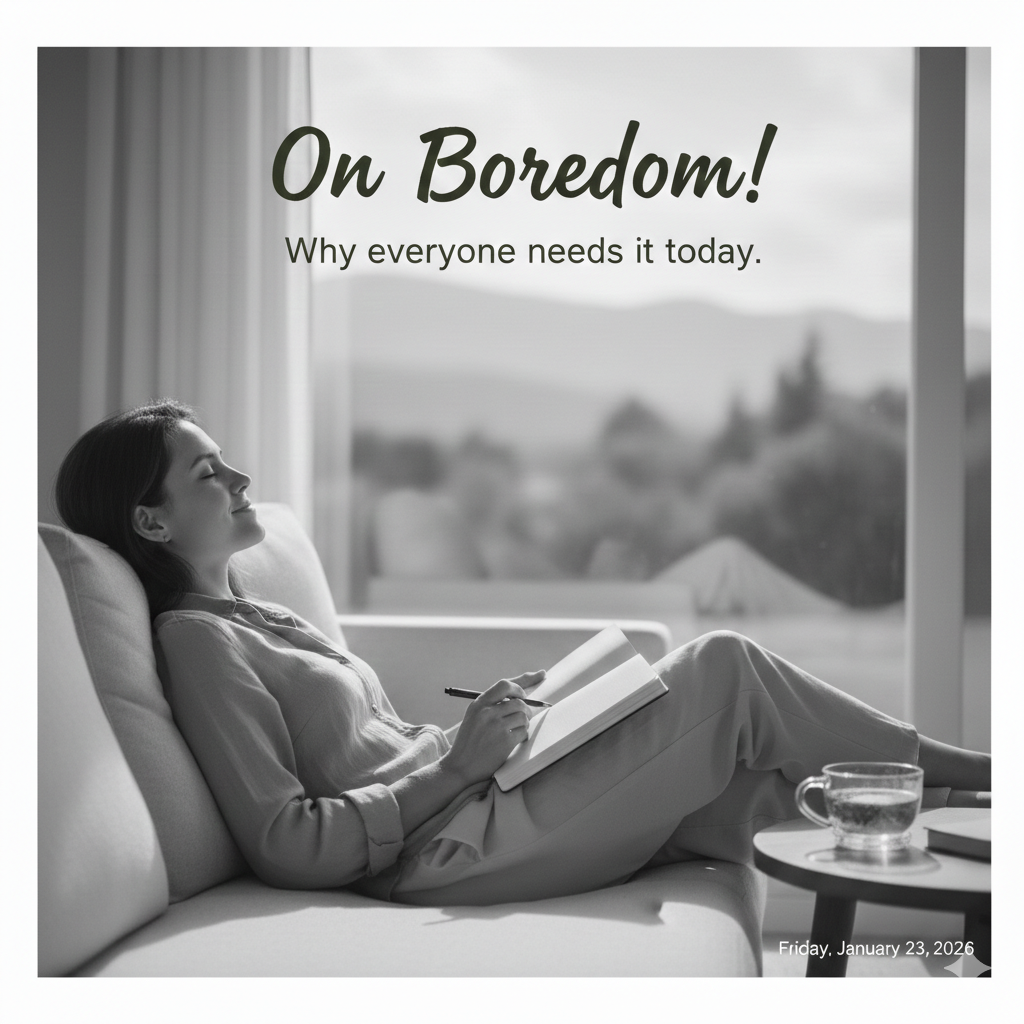
When Stillness Feels Uncomfortable
We live in a world that leaves no empty space. Every gap is filled. Waiting rooms have screens. Elevators have music. Walks have podcasts. Even moments that once belonged to silence are now occupied, not because we need the information, but because we cannot tolerate the feeling of nothing happening.
In the process, we confuse stimulation with depth.
When the mind is constantly fed, it rarely gets the chance to digest. Boredom creates that missing space. When distractions fall away, the mind turns inward. Thoughts begin to wander. Slowly, old questions surface. New connections form. What if this is the mind shifting into a deeper mode of work, one that rarely activates when we are busy consuming.
What Constant Stimulation Costs Us
There was an experiment Brooks mentioned that stayed with me. People were asked to sit alone with their thoughts for a short period of time. No phone. No reading. No task. Many found it so uncomfortable that they chose to give themselves a mild electric shock rather than remain bored.
The detail is unsettling, not because of the shock itself, but because of what it reveals about our relationship with stillness.
We would rather feel pain than sit with nothing.
Often, boredom brings us face to face with questions we have been postponing. Am I happy with how I am spending my time. Why does this work feel empty. What am I avoiding thinking about. These questions do not appear when life is loud. They surface when the noise drops.
So we keep the noise alive. We tell ourselves we are being productive, learning, staying informed. Sometimes that is true. Often, it is just a way to stay distracted.
Boredom exposes the gap between motion and direction.
The Thoughts That Surface When Noise Fades
In my own experience, moments of clarity rarely arrived when I scheduled them. They appeared during long walks without headphones, slow afternoons with nothing planned, and stretches of travel where there was no signal and no alternative but to wait.
At the time, those moments felt unproductive. Looking back, they were recalibrations.
We often say we do not have time to think. More accurately, we have removed the conditions that make thinking possible. Boredom is one of those conditions. It does not demand action. It asks for presence. It asks that we stay long enough for something deeper to surface.
Boredom as Mental Fasting
It helps to think of boredom differently. What if boredom is to the mind what hunger is to the body.
We know this much about food. Constant eating is not the way to be healthy. Even good food, taken all the time, overwhelms the system. The body needs space between meals. It needs pauses to digest, reset, and recover. At times, it even benefits from fasting. The absence of food is not neglect. It is part of nourishment.
The mind seems to work the same way.
We treat boredom like starvation. The moment it appears, we rush to feed it. A scroll, a video, background noise, something to consume. Not because it is meaningful, but because we cannot tolerate the feeling of mental emptiness. Constant stimulation becomes mental snacking, always something coming in, with no time to process what is already there.
Boredom, in this sense, becomes a form of fasting. A pause from mental consumption. A space where thoughts settle instead of being buried under fresh input. At first, it feels uncomfortable, much like skipping a meal does. The system protests. But beneath that discomfort, something else begins to happen. Sensitivity returns. Perspective sharpens. You begin to notice what actually matters.
Of course, fasting is intentional. Done carelessly, it can weaken rather than strengthen. The same is true for boredom. There is a difference between choosing stillness and being trapped in it, between stepping back and shutting down. And yes, one does have to be careful not to be bored and hungry at the same time. It could spell trouble for anyone in that condition.
Chosen well, boredom becomes restraint rather than deprivation.
Boredom is not wasted time.
It is unclaimed time.
And in a world that competes relentlessly for our attention, that pause may be one of the most nourishing choices we can still make.
Credit: Reflections inspired by a talk by Arthur C. Brooks on boredom, meaning, and mental well-being.
Comments
One response to “on boredom! Why everyone needs it today”
It’s fascinating how gaming evolved – from simple dice to complex algorithms! JBoss’s focus on RTP & RNG, averaging 96.2-97.8%, shows a commitment to fair play. Curious to learn more? Check out jboss download apk for a modern take on gaming!