Most of life does not begin after obstacles disappear. It begins inside them.
The Chair in the Doorway
As a young actor, Michael Caine was rehearsing a scene when something unexpected happened. A chair got stuck in the doorway and blocked his entrance. He stopped and told the other actor that he could not get past it. The response he received stayed with him for life: use the difficulty. If the scene is a comedy, fall over the chair. If it is a drama, smash it. If it is serious, move it slowly and enter. The instruction was simple, but its meaning was profound. The obstacle was not the problem. The obstacle was the material. It appeared not as advice for actors, but as a way of living
Many years after hearing this story, I encountered the same idea again in book, The Obstacle Is the Way, by Ryan Holiday. What stands in the way becomes the way forward. The obstacle is not something to wait around. It is something to use. This insight, drawn from Stoic philosophy and carried forward through generations of thinkers, shifts how we interpret difficulty in our lives.
We Think Obstacles Are Interruptions
Most of us carry an assumption about how progress is supposed to happen. We believe that first the path should become clear, then the conditions should become right, and only then should we begin. When something blocks our way, we interpret it as a signal to pause. We tell ourselves that the timing is not correct yet and that we should wait for a better moment.
The Stoics saw this differently. They believed obstacles are not interruptions to progress. Obstacles are part of progress itself. If the obstacle is part of the path, then waiting for it to disappear means waiting for the path itself to disappear.
Actors Understand Something We Often Forget
Actors understand something about movement that we often forget in daily life. The stage is never perfect. A prop is misplaced, a cue is late, a line is forgotten, or something unexpected appears. The performance continues anyway. So actors learn to respond instead of retreat. A chair in the doorway becomes part of the scene. A mistake becomes part of the moment. A delay becomes part of the rhythm.
Life works in the same way. It does not pause until conditions improve. It keeps moving, and the question is whether we move with it.
The Stoic Insight Behind the Story
Centuries before this rehearsal room moment, Marcus Aurelius captured the same idea in a sentence that has endured because of its clarity: what stands in the way becomes the way. This is the central idea behind The Obstacle Is the Way. It is not about pretending difficulty is pleasant or denying that obstacles exist. It is about learning to work with what already exists instead of waiting for something better to arrive.
The Stoics spoke about three responses that remain available to us at all times: perception, action, and will. We can choose how we see a situation, we can choose what we do next, and when neither is possible, we can choose how we endure it. Even when circumstances are fixed, response is still open, and that freedom is often enough to begin again.
The Quarter Percent Advantage
Michael Caine later explained something even more practical that makes this philosophy easier to live with. He said there is never anything so bad that you cannot use some part of it, and if you can use even a quarter percent of a difficulty to your advantage, you are already ahead. This is a powerful idea because it removes the pressure to transform everything at once. We do not need perfect clarity before we begin. We do not need ideal confidence. We do not need complete control.
Even a small shift in direction changes what becomes possible next, and that is often enough to create movement where there was none before.
Most of Life Happens in the Doorway
We often imagine that life begins after obstacles disappear. We think things will start once the promotion arrives, once uncertainty settles, once the schedule clears, or once confidence returns. The point we may be missing is that most of life happens before those things happen. It happens while decisions are incomplete and timing is uncertain. It happens while the doorway is still partially blocked.
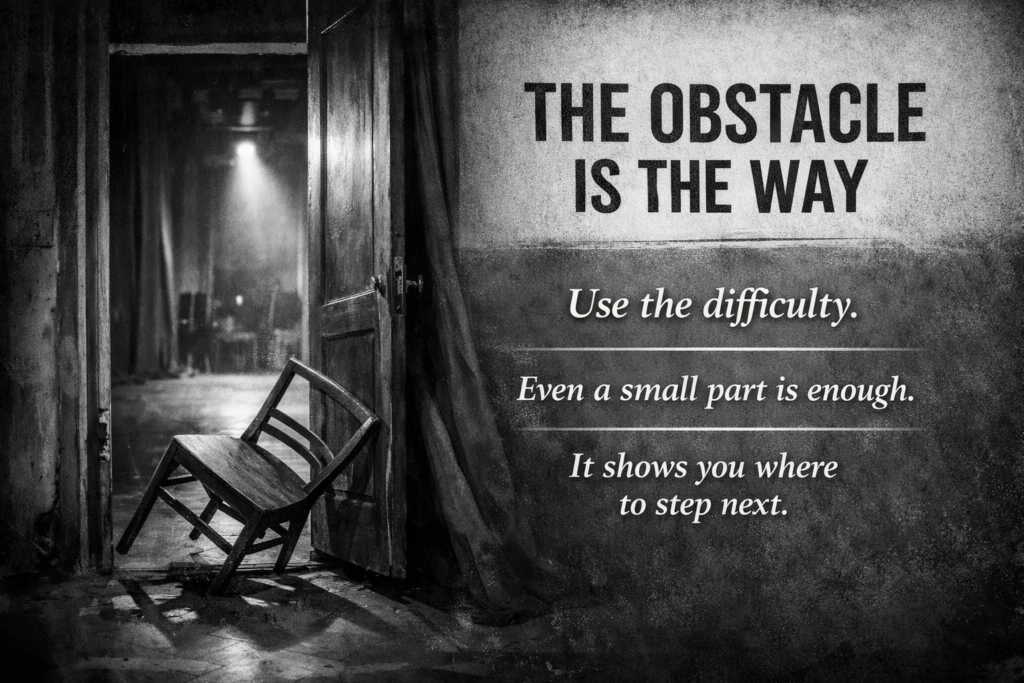
The chair does not leave the doorway first. We enter anyway, and in doing so we discover that movement itself creates clarity.
Difficulty Is Not the Enemy
There is another assumption we rarely question. We think difficulty means something is wrong. Sometimes difficulty is simply information. It tells us where attention is required and shows us what matters. It reveals what we have been postponing and what we have been avoiding. Constraints sharpen thinking, delays clarify intention, and resistance exposes hesitation.
The obstacle is not preventing movement. It is shaping it and using it.
The Instruction Is Always the Same
There will always be something in the doorway. Time, fear, responsibility, uncertainty, and the expectations of others rarely disappear before we begin. They appear because we begin. The instruction that Michael Caine received in that rehearsal room continues to apply in ways that are larger than acting and more personal than philosophy.
Use the difficulty. Even a small part of it is enough. Consider that the obstacle is not standing against us. It is showing us where to step next.
Comments
7 responses to “Use the Difficulty”
OMG, this whole setup sounds wild! The slot options look legit, but check out pinaylulu app for more vibes. Totally different feel than what I was used to! 🤯
Understanding the nuances of digital gaming requires more than just knowing the games; it’s about the framework. For beginners, focusing on transparency is key. Check out fb001 slot for a deeper dive!
This platform seems user-focused, which is key for newcomers. The emphasis on smooth navigation, beyond just the game variety, is smart. Check out superkings slot download for a good starting point!
The breadth of options at p828 is impressive. Focus on that seamless access across devices; it really elevates the user flow. Check out p828 link for a solid overview.
Honestly, mobile-first design really matters; that seamless feel they describe is key. Checking out 1plus game seems super intuitive for quick fun on the go! 🎮✨
This whole ‘layered system’ idea is interesting! It’s more than just games; it’s about flow. For checking out similar vibes, you might check bet100 apk game.
Wondering about the odds breakdown? It reminds me of how deep the analysis on felbet com goes. Makes you rethink your whole strategy, not just the slots!