What happens when our restless thoughts meet structured AI and a second brain built to give them direction?
As we have seen before, we have a restless genie inside us: our mind. It is super powerful. It can imagine and create stuff, solve problems, learn new things and do almost any work we give it. However, when it is not given a task, it can consume us. It can cause worry, use the overactive imagination and make us run in circles. That is why we have to learn how to use it well, instead of letting it use us.
The restless genie needs work. Not just any work, but the right kind of work. If we are not careful, it can consume our attention and, by extension, our life.
As if that problem was not enough, the gods, or maybe we ourselves, decided to give this age a booster dose of power. AI, which stayed for a long time on the sidelines of science fiction movies, novels, labs, and future predictions, has now jumped into the scene with full force. It creates awe and fear in our minds at the same time. So now the restless genie inside us has met another powerful genie outside us.
In the previous article, I explored AI as a tool and how it can support our work, learning, and chances. I want to take that thought higher now. What happens when the restless mind meets structured AI? What happens when both are supported by something like a second brain? Can we create more connections, better direction, and a stronger way of thinking?
Of course, using AI along the way.
This is where the idea of a second brain becomes important. A second brain is not just a notes app. It is not just a folder full of bookmarks, screenshots, and half written thoughts. It is a personal knowledge system where we collect our experiences, ideas, questions, projects, and patterns. It becomes the memory layer between our restless mind and structured AI.
Tiago Forte, known for his work on building a second brain, makes an important point in the AI context. The bottleneck is no longer generating information. AI can generate more than we can consume. The real bottleneck is context. What do we collect? What do we curate? What part of our lived experience do we give to AI so that it can help us in a way that is actually ours?
Without personal context, AI can make us faster, but what about direction? With personal context, it can become a sharper thinking partner.
That is an important distinction. Most AI models are trained on large amounts of internet data. That means they can give us access to a huge amount of knowledge, but they do not automatically know our life or our work. AI has no access to the unique struggles that have shaped our life experiences. If we want AI to help us better, we need to give it better context.
This changes how we should look at productivity. The goal is not to ask AI random questions and collect random answers. The goal is to build a context stack around our life. Our work context, learning context, personal goals, unfinished ideas, and active projects should not all be mixed into one messy dump. There is a need for structure. Otherwise, the same AI that helps us can also confuse us.
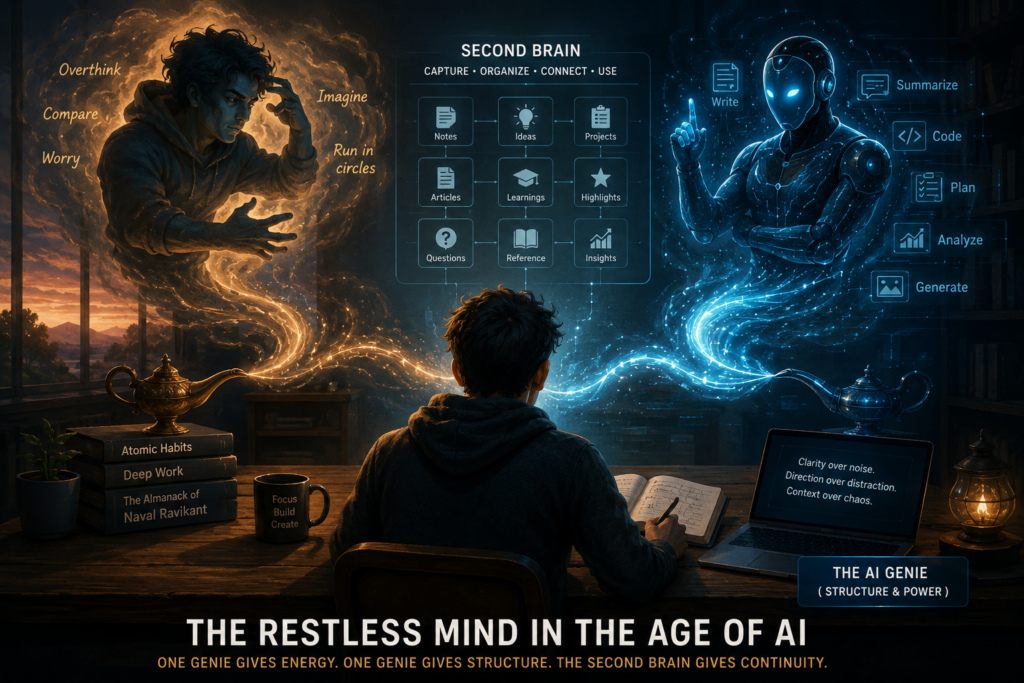
The restless mind produces sparks. AI gives those sparks structure. The second brain preserves them, connects them, and makes them available when needed.
That combination is powerful, but it also puts responsibility back on us. AI will not automatically know what matters to us. It will not know our direction unless we give it direction.
Maybe the next productivity skill is not just prompt engineering. Maybe it is context engineering for our own life.
We need to learn what to capture, what to ignore, what to revisit, and what to express. We need to build a personal operating manual that tells AI who we are, what we are trying to build, what constraints we have, what kind of advice we need, and what kind of person we are trying to become.
This personal operating manual does not have to be perfect. It can grow with us. It can include our current projects, our long term goals, our writing style, our work responsibilities, our learning interests, and even the kind of feedback we want.
Then AI stops being only a tool. It becomes a mirror or show us the what we are doing and where we may be missing certain steps. Sometimes it can even be a challenger. All this can happen only if we bring ourselves into the conversation and share the relevant stuff as context.
There is also a risk here. A restless mind with powerful AI can create more noise if there is no direction. It can create more drafts, saved links, ideas, and plans. It can also add to the pile of unfinished projects. We may feel productive because we are generating more, but adding more unfinished projects is not the same as progress.
The second brain is useful because it can help us slow down, organize, revisit, and decide what deserves our attention. So the question is not whether we have powerful tools now. We do. The question is whether our restless mind will use AI to create more noise, or whether we will build a second brain that helps turn that restlessness into action.
One genie gives energy. One genie gives structure. The second brain gives continuity. What are we going to make of them?
Comments
6 responses to “The Restless Mind in the Age of AI”
Honestly, the focus on mobile simplicity makes sense; I get how crucial quick access is. Checking out 1plus login seems straightforward enough for a break! Good overview of platform usability.
This site really digs into the design of these platforms! The layered system idea is key. Check out bet100 apk club for more thoughts on mobile UX. Cool read!
The focus on service quality, as seen with Juan 365 com, is key. Don’t get lost in the flash; robust account management matters most for rational play.
The visual design echoes smart UX principles; those high-saturation spots guide the eye perfectly. For deeper analysis, check out c54 mobi game. Solid structure matters!
Security always demands vigilance. While the platform’s depth is clear, remember that robust account security-like setting up 2FA-is paramount. Reviewing the felbet club details helps, but user diligence remains the best defense. Stay sharp!
This intersection of creativity and AI structure is fascinating. Managing that ‘restless genie’ requires channeling high cognitive energy into focused, rewarding systems. Whether it’s building a second brain or finding structured engagement, the key is maintaining focus. For those seeking a structured mental break, platforms like the og777 app casino offer a great example of guided engagement.