We often imagine life as a linear journey: study hard, get a good job, climb the ladder, settle down, and eventually retire. This straight path feels comforting because it promises predictability and order. It gives us milestones to chase and a sense of control. We don’t like to have errors in our journey. We don’t like to have failures. We want to be victorious, and we want to do that with a sense of certainty, with the expectation that life will follow a course, a charted path.
But real life rarely unfolds in that manner. Careers shift, relationships change, opportunities appear from nowhere, and setbacks arrive uninvited. Life does not move forward in neat, incremental steps. Instead, it often lurches, stumbles, and surprises us. How often in life do we see that there are months when nothing happens, and then a few moments or days when everything happens suddenly? Of course, we have also heard this in the stock markets, where the returns do not appear steadily, nor do the losses. They can all come at once.
The same is true in sports. Think of tennis: we practice for days, weeks, and even months, repeating the same stroke over and over without visible progress. And then one day, something clicks. Suddenly, we start playing that shot with precision and flow. What does that reflect? Is it a linear approach, or a non-linear one? It shows us that progress is rarely smooth or predictable. Breakthroughs often arrive suddenly, after long stretches of apparent stagnation.
This is what we call the non-linear approach to life. It is messy, unpredictable, and uncertain, but it is also rich with discovery, growth, and resilience. While linear living promises order and clarity, non-linear living reflects reality and teaches us to embrace the unexpected.
Why my own path was far from Linear
My life certainly has not followed a completely linear pathway. Education had so many failures at each stage. The setbacks and even the discontinuing of studies at one point were totally unexpected. Given that I was a great student at school, my family had high hopes for my intelligence. However, it was the way to go through setbacks, a few totally unexpected and a few somewhat expected. Yet, life found a way and things worked out.
What does Nassim Taleb teach us about Non-Linearity?
Nassim Nicholas Taleb has written extensively about the dangers of assuming life is linear and predictable. Some of his most powerful insights include:
- Linear expectations versus non-linear reality: In The Black Swan, Taleb shows that the most transformative events such as wars, inventions, or personal breakthroughs are rare, unpredictable, and disproportionately impactful. We expect progress to be gradual, but real change is often sudden and discontinuous.
- The illusion of control: In Fooled by Randomness, Taleb highlights how humans create neat cause-and-effect stories, when in reality, randomness shapes much of our lives. Linear thinking overestimates control, whereas non-linear thinking accepts chance and adapts.
- Optionality: One of Taleb’s most practical insights is keeping options open. Optionality means creating multiple paths to gain with limited downside. Instead of locking ourselves into a rigid track, we design life to capture unexpected upsides through side projects, new skills, or relationships. Optionality thrives in uncertainty, turning randomness into opportunity.
Why Is Life More Like Art Than a Straight Line?
Great art is rarely created through a rigid, step-by-step process. Artists improvise, rework, and often turn mistakes into masterpieces. Similarly, a meaningful life is not built by ticking off a linear checklist. It is crafted through detours, experiments, and the courage to work with what appears broken.
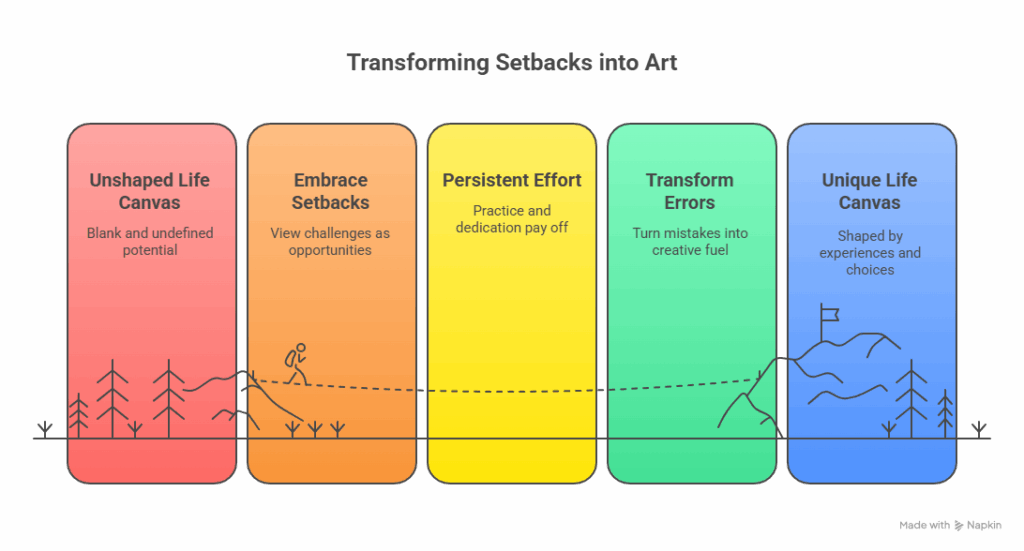
Imagine a life where we make the best of every lemon, turning moments of defeat, error, and loss into moments of triumph and victory. To do that, we may have to give up on the expectation of linear thinking at times and embrace non-linear thinking. Non-linear living allows us to see setbacks not as dead ends but as detours that open up new opportunities.
How Can We Embrace Both Linear and Non-Linear Living?
Both linear and non-linear approaches have value. The linear path provides stability, discipline, and security. But the non-linear path reflects how the world truly works. It is messy, uncertain, full of setbacks, and yet also rich with surprises and growth.
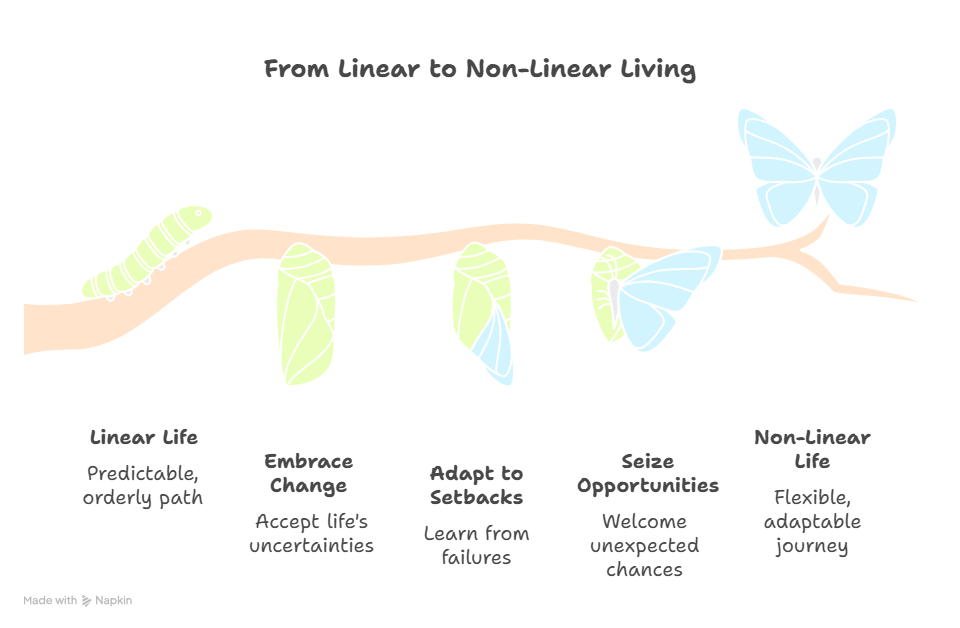
In the end, life is not a straight line but a canvas. Each setback, like a splash of unexpected color, contributes to the bigger picture. Just as in tennis, where countless invisible hours of practice suddenly transform into a perfect shot, life rewards persistence in unexpected bursts. And just as we make lemonade out of lemons, we can turn errors, detours, and surprises into a form of art, shaping a life that may not be linear, but is uniquely our own.
Comments
One response to “Linear vs. Non-Linear: Embracing Setbacks, Surprises and Growth”
Good one