One of the most striking ideas in The Inner Game of Tennis by Timothy Gallwey is also one of the hardest to accept in practice. Gallwey speaks about trusting the body. About imagining the ball landing cleanly across the net and letting the body figure out the how. The idea sounds simple, almost obvious, until you try to live it.
Trust is easy to talk about. It becomes difficult the moment memory enters the room.
Most of us do not come to the court, or to any performance situation, as blank slates. We carry past results with us. Missed shots. Failed attempts. Times when trusting ourselves seemed to backfire. When someone says “trust yourself” from that place, the mind responds with evidence. It remembers. It keeps score. It asks for guarantees.
Gallwey never asks for blind trust. What he offers is something far more grounded and far more workable. Suspend judgement.
Why Judgement Breaks Trust
Judgement feels responsible. It sounds like caution. It promises improvement. In reality, it tightens everything it touches. When judgement runs alongside action, the mind tries to correct in real time. It comments on the swing while the swing is still happening. It evaluates the shot before the follow through is complete.
This is what Gallwey calls Self 1. The voice that narrates, compares, and interferes. Self 1 believes it is helping. It is not malicious. It simply does not understand timing. It reacts too slowly to guide movement and too loudly to stay out of the way.
The body, or Self 2, learns differently. It learns through attention and feedback, not commentary. It adjusts naturally when it is allowed to observe outcomes without being scolded for them.
The conflict is not between effort and ease. It is between interference and awareness.
Our Obsession With the How
This is where the idea becomes deeply personal for me.
I have always struggled with the how. How do I do this. How exactly should this be done. How do I make sure this works. The how feels important, almost sacred. Until I understand it, action feels premature. Risky. Irresponsible.
In many areas of life, intent is clear. Desire is strong. Yet movement is delayed because the how is missing. The mind wants a step by step map before it is willing to take the first step.
Gallwey quietly dismantles this habit.
By asking the player to focus on where the ball should land, not how the arm should move, he reframes action itself. He suggests that clarity of intent can precede clarity of method. That the how does not always need to come first.
This is not recklessness. It is trust in a deeper form of intelligence.
The body already knows more than the mind is willing to admit. When intent is clear and judgement is suspended, the how begins to reveal itself through action, not before it.
Suspending Judgement Is Not Giving Up
Suspending judgement is often misunderstood as being casual or indifferent. It is neither. It is a deliberate choice to postpone evaluation. Not remove it forever. Just delay it.
On the court, this looks like noticing where the ball lands without labeling it as good or bad. It is information, not a verdict. When judgement pauses, attention sharpens. The eyes stay with the ball longer. The body relaxes into the movement.
Judgement collapses experience into identity. One missed shot becomes “I am playing badly.” Observation keeps experience as data. One missed shot becomes “the ball went long.”
The difference sounds small. Its impact is enormous.
Visualization as Non Verbal Instruction
Gallwey’s emphasis on visualization fits neatly into this framework. When a player imagines the arc of the ball clearing the net and landing near the baseline, the mind stops issuing mechanical instructions. The body is given a destination, not a manual.
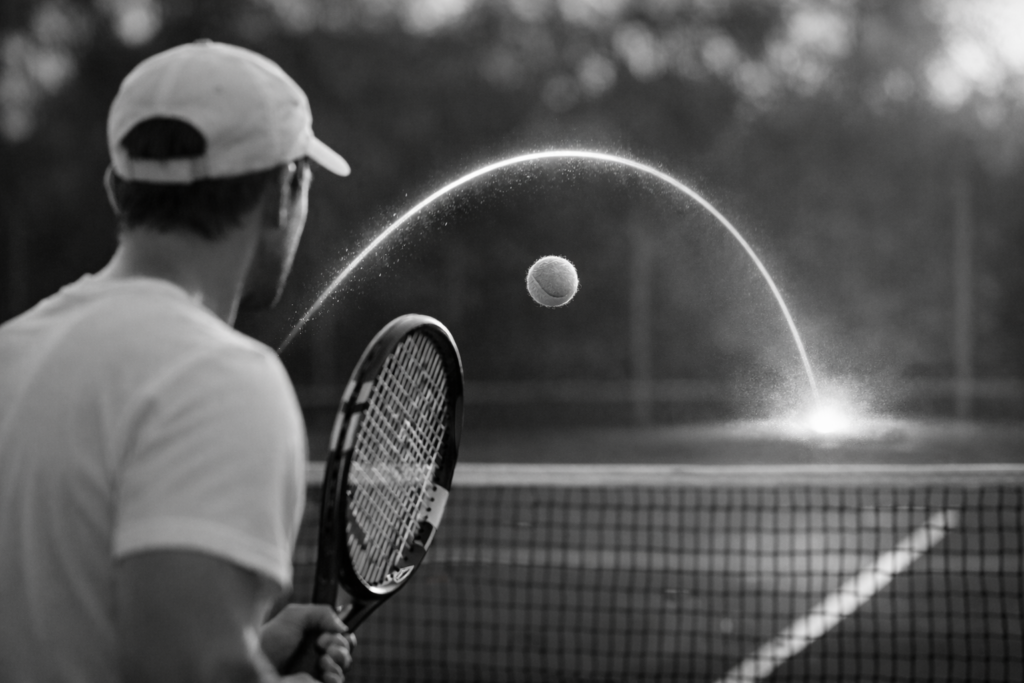
This is a critical shift. Instructions live in language. Movement lives elsewhere. When language dominates, movement stiffens. When intent leads, movement organizes itself.
Visualization works not because it is magical, but because it replaces verbal control with clear attention. The body understands outcomes better than it understands words.
Meditation, But in Motion
The phrase meditation on the court captures the essence of Gallwey’s method beautifully.
In meditation, the instruction is simple. Stay with the breath. When the mind wanders, notice it and return. There is no punishment for distraction. No scorecard. Just awareness.
On the tennis court, the breath becomes the ball. Attention stays with it. When judgement arises, it is noticed and released. The next point begins fresh.
The goal is not calm. The goal is presence.
When presence deepens, trust emerges naturally. Not as a belief, but as an experience.
A Quiet Parallel Worth Noticing
There is a subtle parallel here with Psycho-Cybernetics by Maxwell Maltz, though Gallwey never leans on theory to make his point. Maltz described the mind as a goal seeking mechanism. Set the target clearly, and the system begins to adjust automatically.
No micromanagement. No constant correction. Just direction.
Seen this way, Gallwey’s tennis court becomes a lived demonstration of the same principle. When intent is clear and judgement steps aside, execution improves on its own. The how emerges while doing, not before.
This connection is not necessary to appreciate The Inner Game of Tennis. The book stands firmly on its own. Yet noticing the overlap adds depth for those who enjoy seeing ideas echo across domains.
Playing the Point You Are In
Gallwey is not suggesting we erase memory or ignore feedback. He is asking us not to replay the past while the point is still being played.
The mind wants to manage outcomes. The body wants to engage with what is happening now. When judgement pauses, even temporarily, the two stop fighting.
Trust then stops being a motivational slogan. It becomes a quiet confidence built from repeated moments of presence.
One point at a time.
One shot at a time.
Fully there, without verdict.
That is not just the inner game of tennis. It is the inner game we are always playing.