“One Often Meets His Destiny on the Road He Takes to Avoid It”
There is a line from Kung Fu Panda that lingers long after the scene ends.
Master Oogway says this line to his friend and disciple Shifu when Shifu is fretting about the dangers and how the prison should have extra security to avoid the villain, Tai Lung, from escaping.
At first glance, it sounds like a poetic observation about fate. Sit with it a little longer and it begins to feel more practical than philosophical. It describes something deeply human. The way our attention shapes our direction, often without us realizing it.
We spend much of our lives trying to avoid outcomes we fear. Failure. Embarrassment. Uncertainty. Discomfort. We tell ourselves we are being sensible, strategic, patient. Yet over time, this avoidance starts acting like a steering wheel.
Avoidance Disguised as Wisdom
Avoidance rarely announces itself as fear. It wears better clothes.
“I will wait until things are clearer”
“This is not the right time.”
“Let me reduce risk before I act.”
Each sentence sounds responsible in isolation. Together, they form a pattern. A pattern where safety becomes the goal rather than growth. Where more energy goes into managing fear than moving forward.
In Kung Fu Panda, Tai Lung’s path to freedom is shaped surprisingly by resistance from the main characters. The very act of increasing the prison security ensures Tai Lung is able to escape from the prison. By the attempt to control what should have been understood. The harder the characters try to prevent an outcome, the more their actions steer events in that direction.
Life has a way of echoing this. What We Focus On Becomes Our Path. There is a simple principle at work here. Our actions follow our attention.
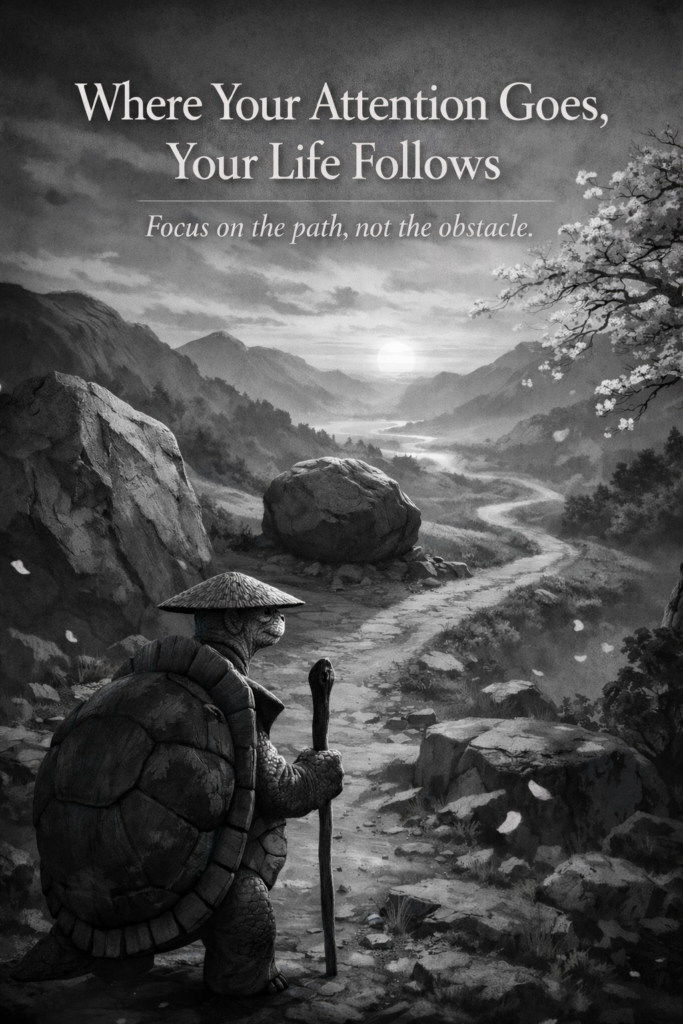
When the focus is on not failing, choices tighten. When the focus is on not being judged, expression shrinks. When the focus is on not making mistakes, movement slows.
Over time, this creates a narrow corridor of action. Not because options disappear, but because we stop seeing them.
This is where a story shared by Tony Robbins in Awaken the Giant Within fits seamlessly into Oogway’s insight. Robbins describes a driving instructor explaining what to do when a car starts skidding toward a boulder. The instinctive reaction is to stare at the obstacle. Fear pulls the eyes toward danger. Almost every time, the car crashes straight into it.
The instructor gives a different instruction. Do not look at the boulder. Look at the open road. Look at where you want the car to go. Because the hands follow the eyes. And the car follows the hands.
Where attention rests determines direction.
The Trap of Staring at the Boulder
Most of us live with our eyes fixed on the boulder. It shows up in different forms in our lives. The mistake we must not make. The outcome we must not face.
We fight it out in our heads to ensure we don’t get to such instances or to ensure we never repeat them. We believe that constant vigilance will protect us. Instead, it keeps us locked onto the very thing we want to escape. Decisions become defensive. Creativity reduces. Courage gives way to calculation.
Oogway never asks Shifu to fight the future. He asks him to see clearly. To stop reacting to fear and start responding to reality.
Asking a Better Question
Most people ask, How do I avoid this? It could be avoid disappointment or avoid regret or even avoid being wrong.
A better question is simpler and more honest.
What deserves my attention right now?
Not what might go wrong. Not what could hurt. Instead, attention shifts to what the present moment is actually asking of you. When attention moves from avoidance to alignment, something subtle changes. Decisions feel cleaner. The noise reduces. Action becomes more direct. One finds that they stop steering away from imagined dangers and start moving toward what matters.
A Reflective Ending
You cannot steer away from danger while staring at it. You cannot move forward while your eyes remain fixed on what you fear. Much of life is not shaped by the obstacles in front of us, but by where we choose to place our focus when they appear.
The boulder will always exist. So will uncertainty. So will risk. The real choice lies in whether you keep staring at them or lift your eyes and look for the way through.
Sometimes, the shift that changes everything is not dramatic.
It is simply a decision about where you focus next.
Comments
2 responses to “Where Your Attention Goes, Your Life Follows”
It’s interesting how much strategy goes into modern slots! Seeing platforms like Fachai focus on RTP & transparency is a big step up. Thinking of checking out the fachai apk to see those stats in action – responsible gaming is key, right? 🤔
Interesting read! Seeing how platforms like JBoss prioritize certified RNG & RTP (96.2-97.8% is solid) really impacts player trust. Curious about volatility – check out the jboss app download for more! It’s a key factor for me.