Reflections on career choices, AI uncertainty and chances.
I saw a passage from Emerson’s Self Reliance today and one line impacted me: the idea that we have not one but a hundred chances. He writes about a young man who does not settle into one neat profession. He farms, sells, teaches, preaches, edits a newspaper, goes to Congress, buys a township, and keeps moving. From the outside, such a life may look confused. Emerson does not see confusion there. He sees someone who has not postponed his life.
That idea feels important now, because we are living in a time where everyone wants a clear answer to one question.
What should I do for my career?
AI has made this question heavier. Freshers are worried about whether entry level jobs will reduce. Experienced people are wondering whether their skills will remain useful. Most of us want stability, but the market itself keeps changing. Even people who are doing well are not fully relaxed. Somewhere, there is a small fear that the ground below our career may shift.
Of late, I have been thinking about the career choices available and what the future holds for us, whether we are experienced people or someone just entering the job market.
For a long time, we were taught to make life look clear. Study well, get a degree, choose a profession, grow in that path, and become known for one thing. There is nothing wrong with this. Many people build beautiful lives this way. However, not everyone’s life moves in a straight line.
The problem is that society is not very patient with such lives. If a person tries something and fails, we ask what went wrong. If a person changes direction, we ask why they are confused. If a person is interested in many things, we ask them to focus. If a person does not have a clean answer to “what do you do?”, we assume something is missing.
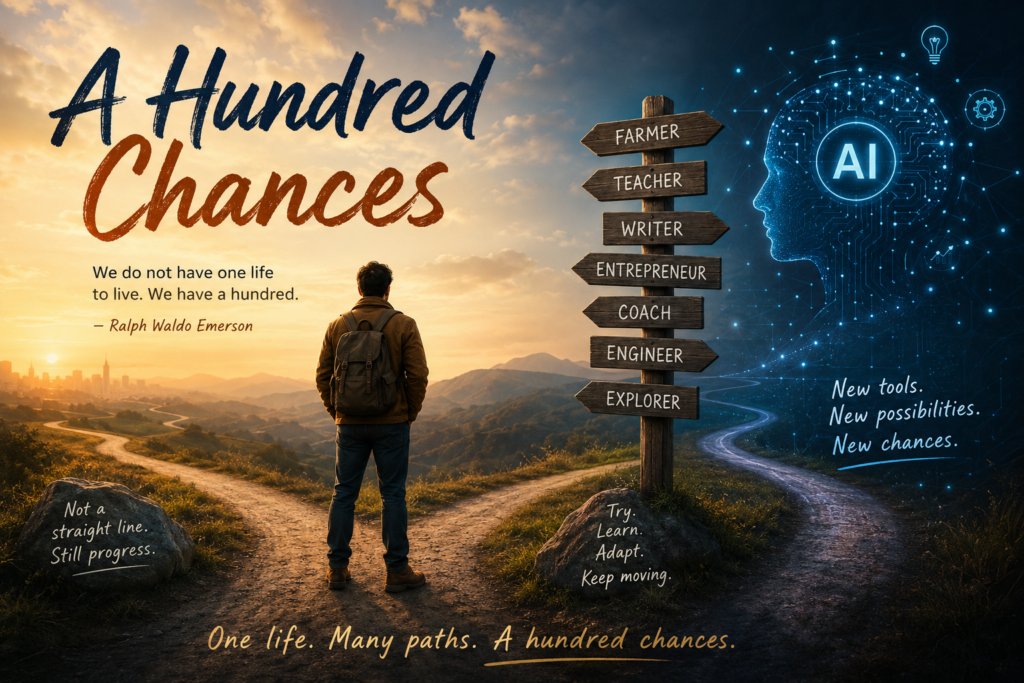
Emerson says the young man has not one chance, but a hundred chances. That line is powerful because most of us live as if we have only one or two. One exam goes wrong and a student feels life has moved backwards. One job does not work out and a person starts doubting himself. One startup fails and it becomes a label. One career switch becomes difficult and we think maybe we are not made for change. I wonder why one attempt should become the final judgement.
A failed attempt may simply be feedback. A side project may become a door later. A skill learned without any immediate use may suddenly become valuable after five years. At the time, these things may look disconnected. Later, they may become the exact combination that helps us move forward.
The other day, I saw my friend perform automations with the help of an LLM agent. The best part was that he had developed it as a side project and it worked wonders! That automation, if applied at scale, could either wipe out jobs or create hundreds of new ones, depending on the way we look at it.
I use AI to support my day to day activities, work automations, drafts, and outputs which would otherwise take me much longer to complete. Even for this blog, I use it to start the initial draft and gather ideas from where I can build upon and write the article. The power of AI is vast, and I may be looking only at the tip of the iceberg. It can open up so many possibilities or close some established pathways.
There is also another kind of fear. The fear of being difficult to explain. We want our lives to look logical on paper. We want every decision to connect neatly to the next one. We want our career to sound sensible when someone asks us about it. Real growth is not always neat.
A person who has lived through different worlds starts seeing connections. The engineer who writes can explain better. The HR professional who understands technology can solve problems differently. The teacher who has worked in industry can speak with more reality. The person who has failed once may become more grounded than the person who has only followed instructions.
An unclear career path can give us more ways to learn, adapt, and survive change. In a world where repetitive tasks are getting automated, the ability to combine different experiences may become more valuable than we think.
I don’t know what the future holds. I mean, if it was a certain future, what’s the fun in it! With AI, it may not remove the need for humans entirely, but it may take out repetitive tasks. If a work involved only repetitive tasks, then it was a matter of time anyway, with or without AI. The question is what value we can provide as humans, and if you look at it, that was always the point of work.
The most important part of Emerson’s passage is not that the young man tried many things. It is that he felt no shame in trying. That is the difficult part, because trying comes with judgement. People may not understand why you are doing something. They may ask what the use is. They may compare you with someone who took a more direct path. They may make your exploration look like confusion.
I personally want to explore AI to know how I can apply it in operations work, coaching, and productivity benefits. I feel the world opening up and it is up to me to make the most of it. This will require work for sure, and that is also the point made by Emerson. Try out stuff! In one of my earlier articles, I wrote about the restless genie inside us, the mind that keeps thinking, moving, and asking for something to do. Now, with AI, it feels like we have another powerful genie to support that restless mind. Take the chances. Try different things with the genie. Maybe the future will reward those who combine two or more skills together and create something valuable.
In a time of insecurity created by AI, maybe the answer is not to freeze in fear. Maybe it is to give ourselves permission to move, to not postpone life until we are fully ready, to not treat every failure as final, and to not reduce ourselves to one profession, one role, or one version of success. One life is large enough to hold many beginnings, many stories. Maybe that is the way forward.
A hundred chances.
Comments
8 responses to “A Hundred Chances”
Great content! Keep up the good work!
The risk assessment on platform access is key; never rely solely on the stated features. Always verify legitimacy before linking funds. Check this out: 111bit app.
This breakdown of online gaming ethics is super helpful! It makes you think beyond just the games. For a deeper dive into platform safety, check out fb001 vip. Good read!
Wow, this breakdown is deep! I was just checking out superkings app; the focus on user flow makes sense. It’s more than just games, right? Gotta nail that smooth experience!
Seriously, the mobile focus described is spot-on for quick gaming breaks! Checking out 1plus app seems like the smoothest way to play now. Great read!
The design focus sounds thorough! Thinking about user flow reminds me of my old teaching diagrams. Check out bet100 apk legit for a solid look at mobile integration.
The platform’s focus on ‘data-backed entertainment’ really resonates with a math enthusiast. It feels less like gambling and more like analyzing probability distributions! Check out felbet download for more structured play.
The underlying math of these systems is fascinating. While the platform details are noted, remember that true edge lies in understanding variance. Check out 999bt গেম for context.